Fishing Adventures
From
Dauphin Island, AL
Captain Jack Gaines
Knowledgeable &
Experienced
U.S.C.G. Licensed
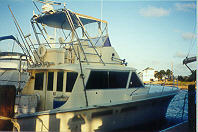 |
1 800 441 2499
(334) 861 3500
|
Quest Fishing Adventures From Dauphin Island, AL Captain Jack Gaines Knowledgeable & Experienced U.S.C.G. Licensed |
|
|
| 1 800 441 2499 (334) 861 3500 |
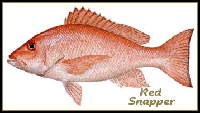
Red Snapper
Description: color pinkish red over entire body, whitish below; long triangular snout; anal fin sharply pointed; no dark lateral spot.
Similar Fish: vermilion snapper, R. aurorubens.
Where found: OFFSHORE on the continental shelf, more plentiful off the panhandle than in south or middle Florida.
Remarks: juveniles occur over sandy or mud bottoms and are often taken in shrimp trawls; adults may live more than 20 years, and attain 35 pounds or more; sexual maturity attained at age 2; spawns June to October; feeds on crustaceans and fish.

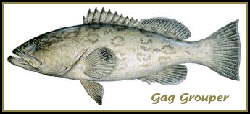
Gag Grouper
Description: brownish gray in color with dark worm-like markings on sides; strong serrated spur at bottom margin of preopercle, less noticeable in large specimens; fins dark, with anal and caudal having white margin. Often confused with black grouper; tail of gag is slightly concave, black is square; gag has white margin on anal and caudal fins, black does not; under 10 pounds, gag's spur on preopercle is distinctive, where black is gently rounded.Similar Fish: black grouper M. bonaci.
Remarks: forms spawning aggregations in water no shallower than 120 feet in Middle Grounds area, January through March; current research to identify similar aggregations off Atlantic coast is ongoing. Young gags are predominantly female, transforming into males as they grow larger; feeds on fish and squid.
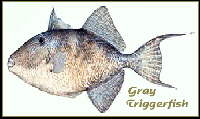
Gray Triggerfish
Description: They get their name from the dorsal fins. Unlike most fish, the trigger has only three stiff dorsal spines and they can lock them in an upright position. The only way to get them down is to push down on the third spine. It acts as a "trigger" and the other two spines will flatten into a groove in the fishes back. Their teeth can crack open a crab shell. Their eyes are set far back from the mouth. The skin of a trigger fish is just like that of the file fish. I've been told that it was used as sandpaper in colonial days.
Where Found: Trigger fish are abundant in the Gulf of Mexico. They can be found year round in our area and they live on just about any rocky or coral encrusted bottom.
Remarks: Their diet consists of crabs, shrimp, sea urchins, and mollusks
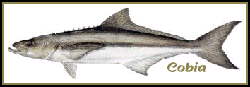
Cobia (sometimes called "Ling")
Similar
Fish: remora, Echeneis naucrates. Where found: both INSHORE and NEARSHORE inhabiting inlets, bays, and frequently seen around buoys, pilings, and wrecks. Remarks:
spawns in spring and early summer; feeds on crabs, squid, and small
fish. Wahoo Description:
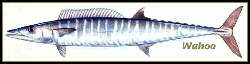
The Wahoo is a long fish with very sharp teeth. The Wahoo is like the
Spanish mackerel but its tail is smaller and more upright. The Wahoo is
also rounder. They are bluish-black in color and have wavy silver
stripes along their sides. The
common weight of Wahoo ranges from 10-50 lbs. Wahoo
is a very good eating fish with sweet, firm, white flesh.
Description:
long, slim fish with broad depressed head; lower jaw projects past upper
jaw; dark lateral stripe extends through eye to tail; first dorsal fin
comprised of 7 to 9 free spines; when young, has conspicuous alternating
black and white horizontal stripes.
Remarks: diet consists of tuna, garfish, mackerel, dolphin fish and squid.
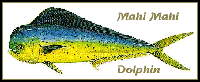
Mahi
Mahi
or Dolphin
Description: bright greenish blue above, yellow on sides, with capability of flashing purple, chartreuse, and a wide range of other colors; body tapers sharply from head to tail; irregular blue or golden blotches scattered over sides; anterior profile of head on adult males is nearly vertical; head of females more sloping; the single dark dorsal fin extends from just behind the head to the tail; anal fin margin concave and extending from anus to tail.
Similar Fish: pompano dolphin, C. equisetis. The pompano dolphin has square-ish tooth patch on tongue (oval tooth patch on dolphin) and fewer dorsal rays (48 to 55 versus 55 to 65 on dolphin).
Where found: OFFSHORE in warm waters.
Remarks: one of the fastest-growing fish, thought to live no more than 5 years; swimming speed is estimated at 50 knots; spawns in warm ocean currents throughout much of the year; young found in sargassum weed; feeds on flying fish and squid.
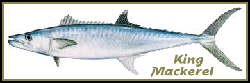
King Mackerel
Description: color of back iridescent bluish green; sides silvery, streamlined body with tapered head; no black pigment on front of dorsal fin; lateral line starts high and drops sharply below the second dorsal fin; young fish often have yellow spots like those of the Spanish mackerel.
Similar Fish: cero, S. regalis; Spanish mackerel, S. maculatus.
Where found: NEARSHORE and OFFSHORE, occasionally taken from piers running into deep water.
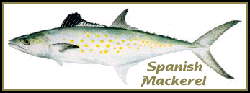
Spanish Mackerel
Description: color of back green, shading to silver on sides, golden yellow irregular spots above and below lateral line; front of dorsal fin black; lateral line curves gently to base of tail.
Similar Fish: cero, S. regalis; king mackerel, S. cavalla.
Remarks: schooling fish that migrates northward in spring, returning to southerly waters when water temperature drops below 70 degrees F; spawns OFFSHORE, spring through summer; feeds on small fish and squid.
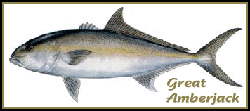
Amberjack
Description: dark stripe (variably present) extends from nose to in front of dorsal fin and "lights up" when fish is in feeding mode; no scutes; soft dorsal base less than twice the length of the anal fin base.
Similar Fish: other Seriola.
Where found: OFFSHORE species associated with rocky reefs, debris, and wrecks, typically in 80 - 240 feet of water.
Remarks: largest of the jacks; thought to spawn OFFSHORE throughout most of the year; feeds on squid, fish, and crustaceans.
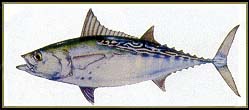
Bonito
Description: Metallic blue dorsally with wavy dark line; chest region with several irregularly placed black spots. Caudal strongly lunate, body streamlined, several finlets above and below the midline.Similar fish: other tunas, especially blackfin.
Where found: near to OFFSHORE in small to moderate schools; often feed in near the surface.
Size: common to 12 pounds, rarely approaching 20 pounds.
Remarks: This is an extremely hard fighting fish. As a member of the tuna family, its reputation as a trash fish is ill deserved, but must be bled and marinated for best eating.
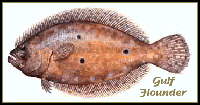
Gulf Flounder
Description: body color brown, its shade depending on color of bottom, with numerous spots and blotches; 3 prominent eye-like spots forming a triangle; one spot on lateral line, one above, one below; numerous white spots scattered over body and fins (albigutta, white-spotted); strong canine-like teeth; caudal fin in shape of wedge, its tip in the middle.
Similar Fish: southern flounder, P. lethostigma (no eye-like spots; color pattern is key to distinguishing the two species).
Where found: INSHORE on sandy or mud bottoms, often ranging into tidal creeks; occasionally caught on< NEARSHORE rocky reefs.
Size: common to 2 pounds, generally smaller than southern flounder.
Remarks: hatches into usual fish form, but right eye migrates over to left side early in life; a bottom dweller; thought to spawn OFFSHORE; feeds on crustaceans and small fishes.
*Does not represent any current records, or catches not officially recorded or documented.
| Home | See The Boat | |
| FAQ | Reservations | |
 |  | |
| © 2000 | ||